Bakuchiol is the plant-derived alternative men reach for when retinol turns their face into a peeling, red mess. It works slower and gentler — but "gentler" doesn't mean "foolproof," and going in wrong still causes irritation.
- Start bakuchiol twice a week at night — that's the core of how to use bakuchiol for men without irritation.
- Buffer every application with a moisturiser to cut down on redness and tightness.
- Bakuchiol works slower than retinol — expect visible texture change around week 8-12, not week one.
- Skip AHAs or vitamin C the same night until your skin has adjusted for at least three weeks.
- Patch test on your jaw for three nights before it touches the rest of your face.
Why this matters
Most irritation complaints about bakuchiol aren't about the ingredient — they're about the rollout. Men buy a bottle, apply it every night starting day one, stack it with a vitamin C serum in the morning, and then blame the actives when their skin gets tight and flaky by week two.
Bakuchiol is a plant compound that mimics some of retinol's effects on skin turnover without the same level of dryness. That's the whole pitch of it as a retinol alternative — read the OLIRS guide for first-time retinol alternative users if you want the mechanism explained in more depth. But "less irritating than retinol" is a comparison, not a guarantee. In 2026, the men who get the best results from bakuchiol are the ones who treat it like any new active: slow start, real patch test, buffer with hydration.
This guide is the routine, step by step — what to do the first night, what to expect by week four, and what to do when something goes wrong.
What you'll need
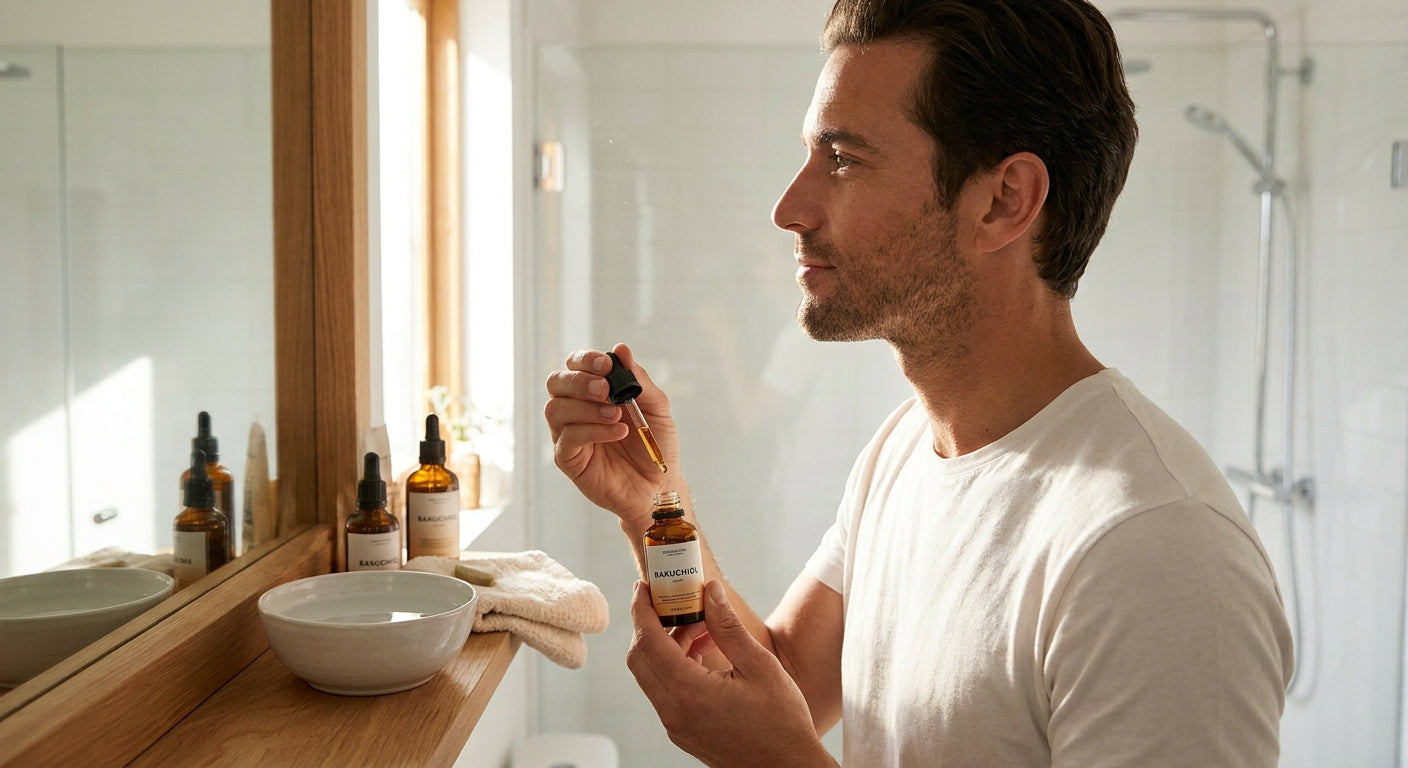
- A bakuchiol serum or oil
- A gentle cleanser you already use
- A moisturiser to buffer application (a retinol alternative moisturiser works, but a plain hydrating one is fine too)
- A small patch of skin — jawline or behind the ear — for the first three days
- A calendar or phone reminder, since the frequency schedule matters more than the product
The steps
1. Patch test before it touches your whole face
Apply a pea-sized amount to your jawline or behind your ear for three consecutive nights before using it anywhere else. This tells you how your skin reacts without risking a reaction across your whole face.
What to look for: mild pinkness that fades by morning is normal. Anything that's still red, itchy, or swollen at hour 24 means stop and reconsider the concentration or frequency.
Common mistake: skipping this step because bakuchiol is marketed as gentle. Gentle relative to retinol still means it's an active ingredient, and everyone's skin barrier is different.
2. Start at two nights a week, not daily
Apply bakuchiol only on, say, Tuesday and Friday nights for the first two to three weeks. This gives your skin barrier time to adjust to the increased cell turnover without compounding irritation night after night.
Daily use from day one is the single biggest reason men report redness and flaking. The ingredient isn't the problem — the ramp-up speed is.
3. Apply to clean, dry skin, before moisturiser
Cleanse, pat dry completely, then apply bakuchiol before your moisturiser. Applying to damp skin increases absorption speed, which sounds good but actually raises irritation risk for a first-timer.
This matters because it accomplishes what the product is meant to do: deliver the active to skin that's ready for it, in a controlled dose, rather than an accelerated one.
4. Buffer every application with a moisturiser
Follow bakuchiol with a moisturiser every single time, no exceptions in the first month. A hyaluronic acid face cream or an oil-free zinc face gel works here depending on whether your skin runs dry or oily.
The moisturiser isn't optional padding — it slows how fast the active penetrates and reduces transepidermal water loss, which is most of what causes that tight, flaky feeling.
5. Hold off on other actives the same night
Don't stack bakuchiol with an AHA, BHA, or vitamin C serum on the same night, especially in month one. Two actives at once multiplies irritation risk instead of adding results.
If your routine already includes an exfoliant, alternate nights: bakuchiol on Tuesday and Friday, exfoliant on Sunday and Wednesday. Give your skin at least 48 hours between different actives while you're still calibrating.
6. Increase frequency slowly, not all at once
After three weeks with no reaction, move to every other night. After six to eight weeks with no reaction, move to nightly if you want. Jumping straight from twice-a-week to nightly undoes the entire point of the ramp-up.
Common mistake: seeing no visible change at week three and assuming more frequency equals faster results. Bakuchiol's turnover effect compounds over weeks, not days — impatience here is what triggers the exact irritation you were trying to avoid.
7. Keep morning SPF in the routine
Bakuchiol doesn't carry the same photosensitivity warning that retinol does, but any active that increases cell turnover benefits from sun protection during the day. This isn't a claim about what bakuchiol does or doesn't require — it's just a reasonable habit for anyone changing their skin's surface layer.
8. Track texture over weeks, not days
Take a photo in the same light once a week. Bakuchiol's effect on the appearance of fine lines and uneven texture shows up gradually — most men notice a difference in the 8-to-12-week range, not the first 10 days.
This won't fix deep scarring or reverse sun damage. It helps skin look smoother and more even over time. That's the honest ceiling, and it's worth knowing going in.


Troubleshooting
Redness and tightness after the third use. Drop back to once a week for the next two weeks before trying twice again. Your barrier needs more recovery time between applications than you gave it.
Small breakouts around week two. This can be the skin purging as turnover speeds up, or it can be the serum sitting on top of too much moisturiser and clogging pores. Try applying a thinner layer before you assume it's the ingredient.
Product balls up or pills on your skin. This usually means you're layering it over a moisturiser that hasn't fully absorbed, or mixing textures that don't sit well together. Apply bakuchiol first, wait 60 seconds, then moisturise.
Skin feels persistently dry by week three. Add a second moisturiser layer at night, or switch to a heavier cream instead of a gel. Bakuchiol increasing turnover naturally increases water loss until your barrier catches up.
No visible change after a month. Normal. Bakuchiol works on a slower timeline than retinol — give it the full 8-to-12-week window before deciding it's not doing anything.
Irritation that doesn't fade after 48 hours. Stop use and let skin fully recover before restarting at a lower frequency. If shaving is also part of the irritation picture, the face serum for razor burn and irritation guide covers how to separate shaving irritation from active-ingredient irritation.
Tools and resources
- A bakuchiol serum or oil, applied on a fixed schedule, not daily by default
- A retinol alternative moisturiser to buffer the active on application nights
- A gentle cleanser — harsh cleansers before an active night compound dryness
- SPF for daytime, regardless of what active you used the night before
- A weekly photo log to judge texture change honestly instead of guessing
What to do next
Once bakuchiol is settled into your routine at three or more nights a week with zero irritation, the next question is usually sequencing it with other actives — vitamin C in the morning, an exfoliant on off-nights, that kind of thing. That's a separate routine-building question, and it's worth getting the order right before adding anything else.
FAQ
How do you use bakuchiol for men without irritation?
Start at two nights a week, apply to dry clean skin before moisturiser, and buffer every application with a hydrating cream. Increase frequency only after three weeks with no reaction.
Is bakuchiol better than retinol for men?
Bakuchiol tends to cause less dryness and peeling than retinol, but it works more slowly on fine lines and texture. It's the trade most men make when retinol has already caused irritation.
How long does bakuchiol take to work?
Most men notice a visible change in skin texture and evenness around 8 to 12 weeks of consistent use. Expecting results in the first two weeks is the most common reason people quit early.
Can you use bakuchiol every night?
Only after a ramp-up period. Start at two to three nights a week for the first three weeks, then increase gradually if your skin shows no redness or flaking.
Can you use bakuchiol and vitamin C together?
Yes, but not always on the same application. Vitamin C in the morning and bakuchiol at night is the safer split while your skin is still adjusting.
Does bakuchiol require SPF?
Bakuchiol doesn't carry the same sun-sensitivity warning as retinol, but daytime SPF is a reasonable habit any time you're changing your skin's surface layer.
Why does bakuchiol cause breakouts sometimes?
A short purge phase can happen as cell turnover speeds up, or breakouts can come from layering too much moisturiser on top. Thinning out your layers usually resolves it within a week.
What percentage of bakuchiol should men start with?
Concentration matters less than frequency for most first-time users. Sticking to twice-weekly application controls irritation more reliably than hunting for a specific percentage.
One last thing
The ramp-up schedule matters more than the product you buy. A man using a mediocre bakuchiol serum twice a week with a moisturiser buffer will see fewer problems in 2026 than a man using the best bottle on the market nightly from day one. Frequency is the lever that actually controls irritation — not the ingredient list.